Start with the complete movement pattern
A facility drawing can make a biathlon complex look deceptively simple: trails, a stadium and a range. The operational questions begin between those labels. Which route returns athletes to the stadium? Where can a coach observe without obstructing movement? How do maintenance staff reach equipment without entering an active training corridor? A useful review follows an entire session rather than inspecting each asset in isolation.
Map athletes, coaches, officials, service vehicles and visitors separately before combining their routes. A crossing that appears harmless during a quiet inspection can become a bottleneck when several groups train at once. Equally, a large stadium is not automatically a clear stadium. Unnecessary distances between changing facilities, equipment support and the session's starting point can add friction without improving training quality.
Read the approach before the central space
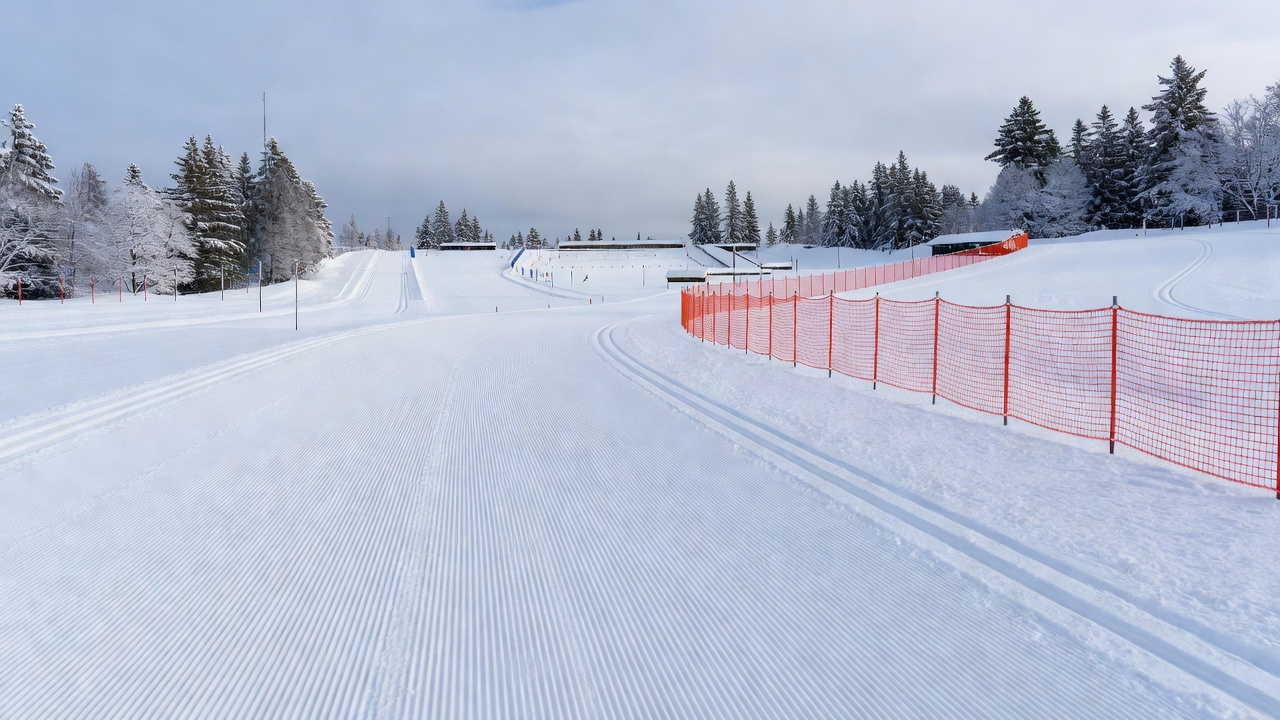
The return from the ski network determines how people arrive at the controlled interface. Gradient, curve geometry, visibility and snow condition all influence the practical character of that arrival. Planners should examine the approach in typical winter light and under realistic maintenance conditions, not only on a clear day with a freshly prepared surface. Temporary event structures can also change sightlines and usable circulation.
The purpose is not to prescribe athlete technique. It is to establish whether the spatial arrangement is understandable and whether authorized staff can manage the activity intended. A public viewing route, for example, should not depend on spectators correctly interpreting a training group's movement. Clear separation, appropriate signage and venue procedures are more dependable than informal expectations.
Give each interface a responsible operator
A boundary is useful only when its meaning is understood. The venue needs to determine who controls access, who can change a session arrangement and how changes reach visiting teams. A coach responsible for a training group may not be the person authorized to open a controlled facility. That distinction should be resolved before arrival, together with applicable local requirements and the operator's rules.
Facilities such as Chiemgau Arena in Ruhpolding, the Oberhof biathlon venue and Südtirol Arena Alto Adige in Antholz illustrate different geographic settings for the same integration problem. Their existence does not imply identical access policies or interchangeable layouts. Compare the relationship between terrain and stadium, then obtain current information directly from each operator rather than transferring assumptions from one venue to another.
Use a three-part transition review
Arrival
Identify the return route, nearby junctions, visibility limits and any overlap with service or spectator circulation.
Supervised interface
Confirm the boundary, responsible personnel, permitted activity and communication arrangements for the session.
Departure and reset
Trace how athletes rejoin the course and how the working area is prepared for the next group without conflicting movements.
This sequence should be reviewed for ordinary training, not just competition. A competition layout may include temporary fencing, dedicated officials and extra transport support that are absent on a weekday. Conversely, daily training may use a reduced area or a different loop configuration. Treat the planned operating mode as a specific condition, not as a smaller version of a major event.
Keep observation and information connected
Coaching observation requires useful sightlines, but it also requires a place to stand, reliable communication and a way to relate observations to the session. Timing displays and video equipment can help, provided their location does not create a new obstruction. Power, weather protection and cable routing belong in the facility review. A technically capable device in the wrong place can make circulation less coherent.
At Holmenkollen in Oslo and at the biathlon stadium in Östersund, the broader lesson for a visitor is to distinguish the visible competition setting from the practical arrangements available for a particular training visit. Published event imagery is contextual evidence, not an access agreement. Ask which zones, services and observation positions are actually available on your date.
Define success through fewer conflicts
A well-integrated transition does not need to be visually elaborate. Its strengths are legibility, manageable interfaces and a clear division of responsibility. Before accepting a layout, ask what happens when a group arrives early, equipment fails or weather interrupts the session. The plan should allow an orderly pause without pushing waiting people into another active area. Those ordinary contingencies often reveal more than the ideal operating sequence.
For competition-related requirements, consult the current materials from the International Biathlon Union and the relevant organizing authority. This article is an interpretive facility guide, not a dimensional standard, safety approval or substitute for an operator's assessment.